Light Load Is the Expensive Part of Generator Running
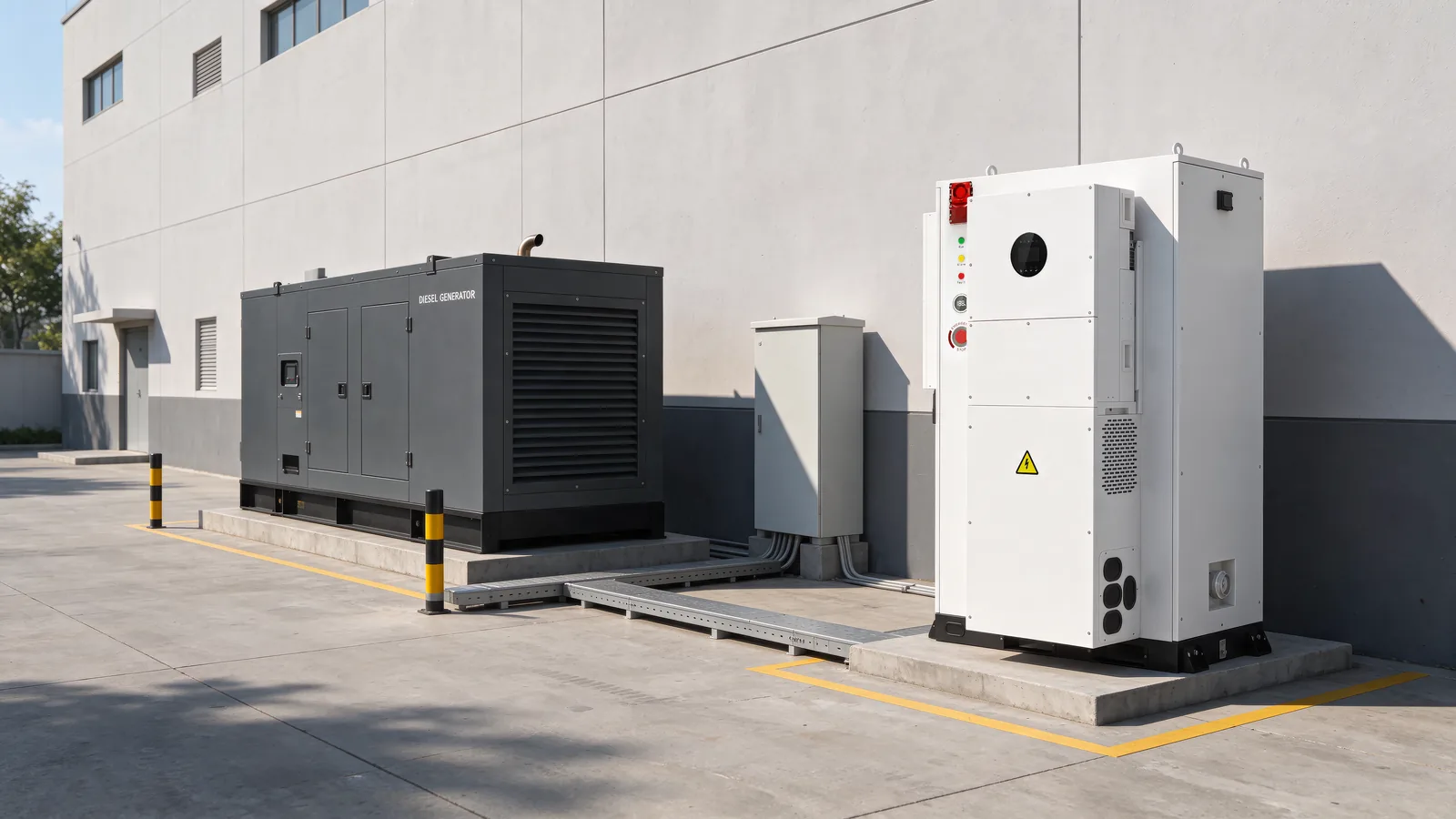
Yes, if the site already runs a diesel generator and the load swings. The cabinet parallels the generator, covers the peaks and the light hours, and lets the generator run in its efficient band. No external ATS is needed because the transfer switch is in the cabinet.
A 250 kVA generator carrying a 40 kW load sits near 20% of its rating. Fuel per kWh rises, the engine runs cold, and the service intervals shorten. The same generator carrying 180 kW is doing the job it was bought for.
The usual fix is a second generator or a larger one. A battery does the same job with less fuel and no second engine to service.
Parallel, With the Changeover Inside the Cabinet
The generator feeds the cabinet's generator input. The cabinet controls the parallel operation, and the internal transfer switch moves the essential board between grid, generator and battery.
- No external ATS and no separate changeover panel on the wall.
- The generator can charge the battery while it runs, so a long outage is covered by fuel rather than stored energy alone.
- Load steps land on the battery first, and the generator picks up the average instead of the spike.
A retrofit needs a signal path from the generator controller to the cabinet. The site check confirms the governor response and the excitation before parallel mode is commissioned.
Who Takes the Step and Who Takes the Average
When a compressor starts, the step lands in milliseconds. The cabinet covers 150% of its rating for 10 seconds. That is long enough for the generator to pick up the new setpoint without dropping the site.
| Step on the site | Cabinet | Generator |
|---|---|---|
| Up to 90 kW | Discharges at 150% for 10 s | Picks up the new average |
| 60 kW continuous | Full rated output | Runs in its band |
| Above 90 kW | At its ceiling | Covers the rest |
Generator sizing follows the largest step rather than the total load. A 100 kVA generator facing a 60 kW step is a different design from one facing a 20 kW step. The proposal states which one the site has.
What Changes in the Fuel Log
The generator runs fewer hours, and the hours it runs sit at a higher average load. Fuel per kWh falls on both counts, and the service schedule stretches with the run hours.
The saving is not a fixed percentage. It depends on the load profile, the generator's part-load curve and the price of diesel at the site. A proposal for this work starts with the generator's load log.
When a Generator Beats a Bigger Battery
A site that needs three days of autonomy should keep the generator and use the battery for the daily cycle. A site with a two-hour outage window can often drop the generator entirely and let the cabinet cover the board.
A site with no generator and no grid connection needs the microgrid design. That means island operation, black start and a changeover arrangement agreed before the cabinet ships.
A North American or Japanese project needs a listing this cabinet does not carry, so it is a different product for those markets.
Terms, Certificates and the Retrofit Checklist
Certificates are CB IEC 62619, CB IEC 63056 and CEI 0-21. Warranty is 5 years on pack, inverter and cooling unit and 2 years on fire suppression. Cover runs from 60 months after installation or 66 after shipment, with extension to 10 years in the contract.
The site check before shipment covers the generator rating, the existing changeover, the cable route and the essential board. Documentation is released within 15 days of contract signature.
Questions about diesel generator + battery hybrid system
Do I need to replace my generator?
No. The existing generator stays, provided its controller can take the parallel signal and its rating covers the average load. The site check confirms both before the cabinet ships, and a generator that cannot parallel is a different design. The generator rating is checked against the average load rather than the peak.
Is an external ATS needed?
No. The transfer switch sits inside the cabinet and moves the essential board between grid, generator and battery. That removes a panel, a set of interlock wiring and a second commissioning step from the site. The internal changeover is wired and tested at commissioning, and the start signal comes from the cabinet controller.
How is the fuel saving calculated?
From the generator's load log: hours at light load, hours at rated load, and the fuel curve for that model. The battery moves light-load hours into the efficient band. We do not quote a percentage before seeing the log. Fuel price and service intervals are site figures, and both go into the same calculation.
Can the cabinet start the generator?
Generator start and black start are set up during design, with the changeover arrangement agreed before shipment. The cabinet controls the sequence, and the site check confirms the generator's own start circuit is compatible. A site with an outage window under two hours can often retire the generator, and the design says which case applies.
Can the generator charge the battery?
Yes. The generator connects to the GEN input and the cabinet can charge from it. Keep the charge rate below the generator's spare capacity, because the site load and the charge current share the same generator.
Why does the generator start and stop in short cycles?
Check two things: whether the start and stop thresholds sit too close together, and whether the generator is large enough for the site load plus the battery's charge power. Widen the dead band and cap the charge current before changing hardware.
Why does the portal show no generator power?
Generator power is measured, not inferred. If no meter and CT sit on the generator feeder, the portal has nothing to display for it. Add a meter on that circuit and the reading appears in the same view as the grid and the battery.
The Generator Rating and the Load Log
Tell us the generator model, its rating and a week of load data. You get the parallel arrangement, the cabinet count and the fuel case built from your own numbers.