The Transformer Sets the Number of Bays
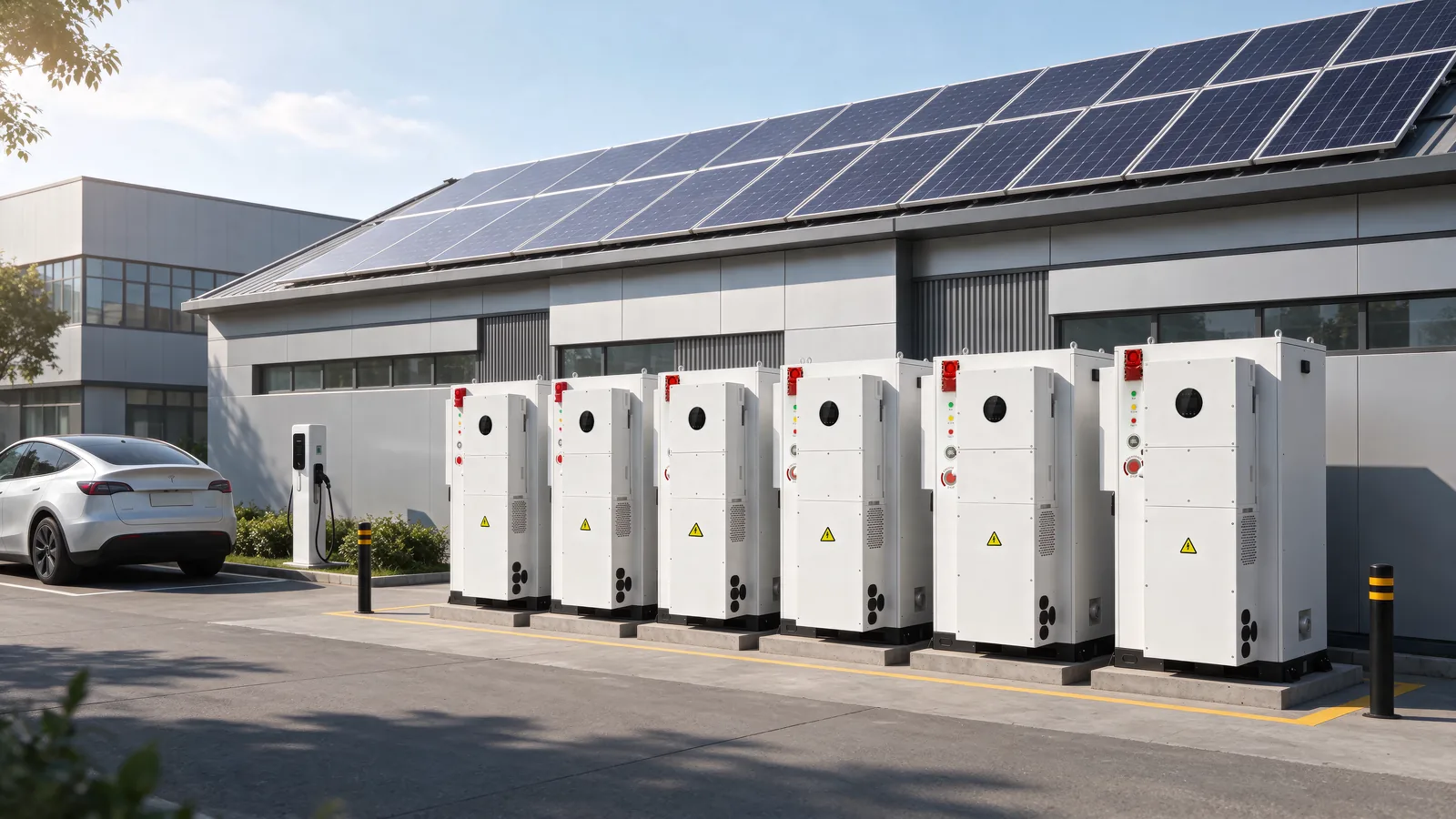
Yes, where the charger load is peaky rather than constant. The cabinet absorbs the peaks the transformer cannot pass and refills between sessions. Two cabinets cover a typical four-bay site, and three cover a hub with a larger charger bank.
A 250 kVA service passes about 250 kVA for short periods. Four chargers running flat out can ask for 480 kW. The gap has to come from somewhere: a bigger transformer, a demand limiter, or a battery.
The battery route keeps the existing service and the existing connection agreement. The site adds bays without waiting for a utility upgrade and without paying for capacity it uses twice a day.
A deployment we can point to: a 240 kW charger added on a site whose connection could not carry it. That project used two 125 kW / 261 kWh units and a 240 kW DC charger, not the LuminBlock H cabinet; the constraint and the logic are the same, the model is not.
Absorb the Peak, Refill Between Sessions
The cabinet measures the site import and discharges whenever the chargers would push it past the agreed limit. The car still sees full power, and the meter sees the limit.
Between sessions, the cabinet recharges from the grid at a rate the service can spare. A 108 kWh cabinet that gives 60 kW for twenty minutes refills during the quiet hour after the lunchtime rush.
- 150% overload for 10 seconds covers the step when a second vehicle plugs in.
- Two to three cabinets cover a four to eight bay site, with 600 kW and 4.8 MWh at the parallel maximum.
- The same cabinet shaves the site's own peaks when no car is charging, which is most of the night.
How Many Cabinets a Charger Bank Needs
| Site | Chargers | Cabinets |
|---|---|---|
| Retail car park | 4 x 60 kW | 2 |
| Highway hub | 6 x 120 kW | 3 |
| Fleet depot | 8 x 22 kW overnight | 2 |
The count follows two numbers: the gap between charger demand and service capacity, and how many hours a day the site is quiet. A hub with traffic all day needs more stored energy than a depot that charges overnight.
A site with no spare capacity at all needs a service upgrade before any cabinet helps. The site survey states the available capacity in kVA, and we size against that figure rather than the charger nameplate.
Where the Cabinet Goes and What It Needs
The cabinet is 1349 mm wide and 2100 mm tall on a 990 mm base, and it stands outdoors. It needs a hardstanding, a cable route to the switchgear and clearance for the cooling airflow.
Civil works and the external cabling sit outside the supply scope, and the site plan names who does them. The cabinet arrives with the inverter, six packs, the BMS, fire suppression and cooling already inside.
The Night Charging Case
A depot charging eight vans overnight draws a flat load for six hours, which is easy for the service and easy for the bill. A public hub draws nothing for hours and then 400 kW, which is neither.
The cabinet charges on the cheap tariff window and discharges into the evening peak. The charging site earns from the chargers and from the site's own demand profile at the same time.
Where the local network pays for demand response, the same cabinet can bid that capacity. The mode is in the controller and is set up at commissioning.
Certificates, Terms and the Honest Limits
Certificates are CB IEC 62619, CB IEC 63056 and CEI 0-21. Warranty is 5 years on pack, inverter and cooling unit and 2 years on fire suppression. Cover starts 60 months after installation or 66 after shipment, extendable to 10.
The cabinet does not make a site suitable for chargers on its own. It moves the limit from the transformer to the stored energy. A site with a 100 kVA service and eight 350 kW chargers is still a service upgrade.
Questions about battery storage for EV charging sites
Can I add chargers without a bigger transformer?
Up to the point where the stored energy covers the daily peak. Two cabinets hold 216 kWh usable across a 60 kW discharge, which covers a four-bay site with a lunchtime rush. A site that pulls its limit for hours needs a service upgrade.
How many cabinets does a hub need?
Two or three covers most four to eight bay sites, depending on the charger rating and the quiet hours. The count follows the gap between charger demand and service capacity, and the site survey states that gap in kVA. A hub with traffic all day needs more stored energy than a depot that charges overnight.
Does the car charge slower on battery power?
No. The cabinet supplies the charger at full power while the site import stays at the limit. The car sees the same rate, and the meter sees the agreed figure. Charging slows only if the pack empties and the site limit binds.
Can it stack revenue with the chargers?
Yes, in markets with demand-response or time-of-use tariffs. The cabinet charges inside the cheap window and discharges into the peak, and it can bid capacity where the local network pays for it. The modes are set up at commissioning. Where the local network pays for capacity, the bid is arranged with the aggregator.
The Service Capacity and the Charger List
Tell us the transformer rating, the chargers and the busiest hour. You get the cabinet count, the discharge window and the peak the site will hold, in writing.