One Quarter-Hour Becomes a Monthly Charge
Yes, on a site with step loads like presses, compressors or welding. The cabinet covers the start, so the quarter-hour demand stays flat. It does not reduce the energy a process uses, and the shift pattern still sets that figure on the bill.
The meter records the average kW in each 15-minute window and bills against the highest. A 400 kW spike lasting four minutes is averaged with the eleven quiet minutes that follow, and the site pays for the average every month.
A demand ratchet makes it worse. Many tariffs bill the highest demand of the last 11 or 12 months. One bad afternoon in July sets the charge until the next June.
The Start Is Where the Money Goes
A 55 kW motor draws several times its running current during the start second. On a 400 V supply that is a step the meter averages across the whole window. It lands at the same moment as every other start on the shift.
The cabinet covers 150% of its rating for 10 seconds, which sits across the start and hands the steady load back to the grid. The motor sees a stiff supply and the meter sees a flat quarter.
- Three-phase imbalance of 100% is handled, so a single large single-phase load does not unbalance the output.
- Power factor is corrected at the cabinet's own output stage, which is billed as part of the site's kVA demand on many tariffs.
- The discharge is controlled, so a 60 kW cabinet can cover the start of a motor larger than its own rating for those ten seconds.
Which Shift Cheaper, Not Whether
A plant on a time-of-use tariff can move the air compressors and the chillers into the cheap hours. The cabinet then carries the expensive ones. The process does not have to move with them.
Refrigeration and compressed air are the usual candidates, because both store their output. A cold store holds temperature for a while, and an air receiver holds pressure. Neither needs the load running for every minute of the peak.
| Load | Moves? | Why |
|---|---|---|
| Compressed air | Partly | Receiver size sets the window |
| Chilled water | Yes | Thermal mass holds the loop |
| Press line | No | The line runs when the shift runs |
Cabinets for a Plant, Not a Shop
One cabinet is 37.5 to 60 kW. A plant with a 250 kW peak and a 90 kW start uses two cabinets for the power. The same two cover the energy, because a 20-minute start window is small against 216 kWh usable.
Ten cabinets in parallel reach 600 kW and 4.8 MWh on one controller, and the plant's existing switchgear stays where it is. Capacity stays consistent across cabinets in a parallel system.
The site survey measures the peak over a month, not a shift. A week includes the day the plant ran its annual clean and a week does not include it.
Where a Cabinet Sits in a Plant
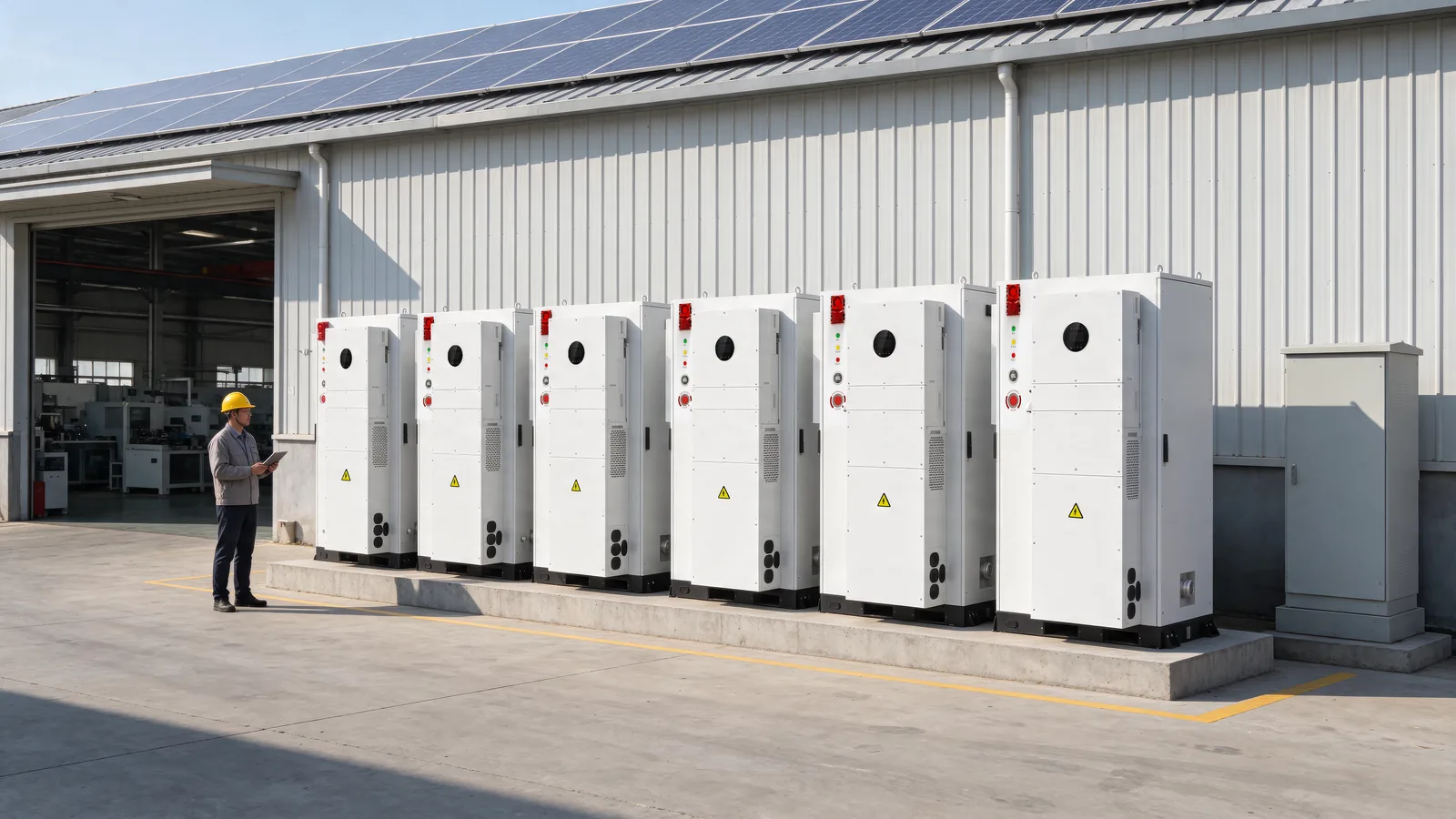
Outdoors on a hardstanding beside the switchroom is the usual position. The cabinet is IP55, the inverter is IP66, and the C5 coating option covers coastal and chemical sites. It occupies 1349 by 990 mm of ground.
The cabinet includes the inverter, the packs, the BMS, aerosol fire suppression and cooling. Civil works, the foundation and the external cabling sit outside the supply scope and are listed in the proposal.
What the Contract Should Say
Certificates are CB IEC 62619, CB IEC 63056 and CEI 0-21. Warranty is 5 years on pack, inverter and cooling unit and 2 years on fire suppression. Cover starts 60 months after installation or 66 after shipment, extendable to 10.
Performance is stated as 6,500 cycles or 10 years to 70% state of health at 25C, 0.5P and 90% depth of discharge. A plant that cycles twice a day reaches the cycle count before the calendar limit.
Questions about factory battery storage
Will it reduce my demand charge?
It reduces the peak that sets the charge, provided the peak is short and repeated rather than a flat all-day load. A plant that draws 400 kW for six hours needs load reduction upstream, and the cabinet is the wrong tool for that.
Can it handle motor starts?
Yes, up to 150% of the cabinet rating for 10 seconds. A 60 kW cabinet carries a 90 kW start for that window. The largest motor on the site sets the cabinet count, and the survey checks the starting current.
Does the demand ratchet go away?
The ratchet keeps the highest month for up to a year, so the cabinet has to hold the peak down every month to matter. It prevents new peaks setting a high ratchet and holds the site at its current level.
What about power factor?
The inverter output stage corrects power factor at the cabinet. On tariffs that bill kVA demand rather than kW, that shows up on the same line as the demand charge. Correction at the motor is a separate decision. A site billed on kVA sees the correction on the same line.
A Month of Interval Data
Thirty days of 15-minute readings show the peak, the start and the ratchet. You get the cabinet count and the demand the site will hold, in writing.