Every Pump Start Lands on the Same Line
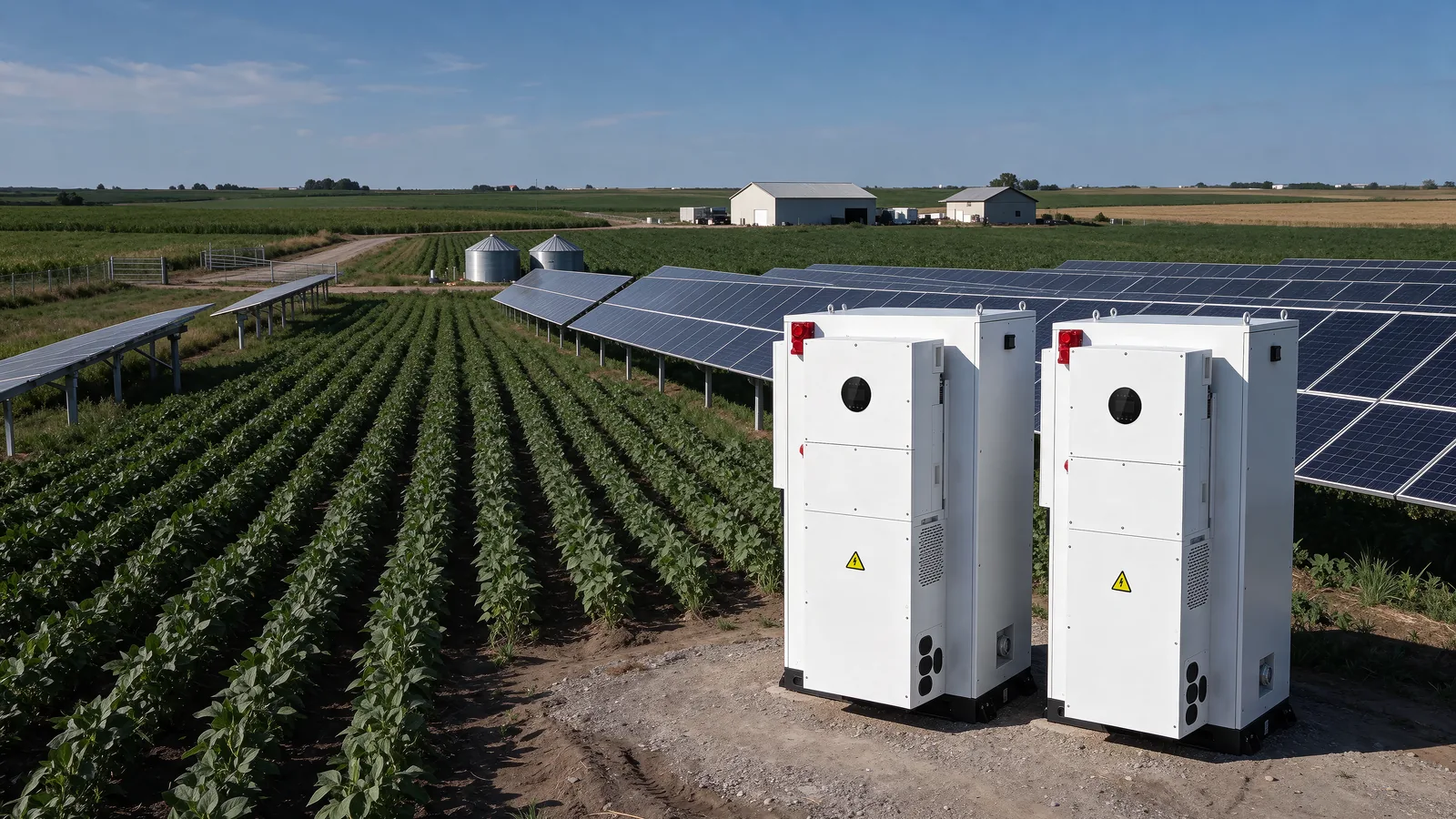
Yes, on a farm with pump, cold store or parlour load. The cabinet covers pump starts at 150% of its rating for 10 seconds and runs the essential board through an outage. It does not make a weak supply into a strong one for a whole season of pumping.
A pump motor draws several times its running current while it comes up to speed. When the irrigation controller starts three pumps in sequence, the farm's demand register records a step. It lasts a few minutes and bills for a month.
The cabinet covers the step and hands the steady pumping load back to the grid. The pumps still start, and the meter sees a flatter quarter-hour.
- 150% overload for 10 seconds covers the starting current of a staged pump set.
- Three-phase imbalance of 100% is handled, which matters on farms with single-phase spurs.
- The essential board keeps the cold store or the parlour live through an outage.
The Pump Does Not Care When It Runs
Water in a tank or a reservoir waits. A pump that runs at 02:00 instead of 18:00 delivers the same water for a lower bill. The cabinet makes that shift without changing the irrigation layout.
The controller charges the pack in the cheap window and discharges it into the expensive one. Pumping runs on the battery in the peak and on the grid overnight, and the schedule stays inside the water authority's rules.
A farm with a time-of-use meter and a night rate has the whole case in two numbers. They are the price gap and the kWh the pump moves. The proposal works from the meter's own interval data.
The Nearest Line Crew Is an Hour Away
Rural outages last longer than urban ones. A cabinet on the essential board keeps the cold store, the parlour and the security lighting live while the line is down.
108 kWh usable covers 15 kW for 7.2 hours or 30 kW for 3.6 hours. A dairy that needs the parlour and the milk tank at 20 kW gets through the night, which is the outage window that matters.
The cabinet is IP55 with a C4 coating as standard and C5 as an option for coastal or ammonia-heavy sites. It stands outdoors beside the pump house and needs a hardstanding rather than a building.
A Farm Usually Has One or Both
PV on a barn roof connects to the cabinet's MPPTs, up to 120 kWp on the 60 kW model. Surplus generation charges the pack instead of being exported at a low rate, and the pack runs the pumps after dark.
An existing diesel set can parallel with the cabinet, which lets the generator run at a steady load and takes the pump starts off it. The transfer switch is inside the cabinet, so no separate changeover panel is needed.
A site with no grid connection at all needs the microgrid design, with the island and black start arrangements agreed before the cabinet ships.
Size for the Pump, Then for the Hours
| Load | What sets the size |
|---|---|
| One pump set | Starting current and running kW |
| Pump plus cold store | The larger of the two, plus the board |
| Whole farm | Peak over a month, not a day |
The starting current sets the cabinet power rating, and the hours of cover set the energy. One cabinet is 37.5 to 60 kW and 80 to 120 kWh. Ten in parallel reach 600 kW and 4.8 MWh for a large operation.
A farm that expands adds battery cabinets for hours or full cabinets for power. The parallel limit keeps one controller across the site.
Terms and the Working Conditions
Certificates are CB IEC 62619, CB IEC 63056 and CEI 0-21. Warranty is 5 years on pack, inverter and cooling unit and 2 years on fire suppression. Cover starts 60 months after installation or 66 after shipment, extendable to 10.
Operating range and derating are set out in the datasheet. A site above 40C average or with a dust-heavy yard should ask for the derating curve before the order. The proposal states the assumption it used.
Questions about farm & agricultural battery storage
Will it start my irrigation pump?
Up to 150% of the cabinet rating for 10 seconds. A 60 kW cabinet carries a 90 kW start. The pump's starting current and its starting method decide the cabinet count, and the survey checks both before quoting. The pump's starting method, direct or soft start, changes the number.
Can I pump at night for a lower tariff?
Yes, where the meter has a night rate and the water schedule allows it. The cabinet charges in the cheap window and runs the pump from the battery in the peak. The schedule stays inside whatever the water authority permits.
Does it work on a single-phase supply?
The cabinet is a three-phase 380, 400 or 415 V unit, so the site needs a three-phase supply. Single-phase backup at up to 22 kW per phase covers lighting, controls and small loads on the farm board. The site survey confirms the three-phase supply and the transformer rating before quoting.
What if the farm has no grid at all?
Then it is a microgrid project rather than a backup one. The cabinet takes PV and generator input, and the island and black start arrangements are agreed at design. A site check comes before the order. The design also states who carries the fuel and the service for the generator.
The Pump Rating and the Meter Data
Tell us the pump motors, the starting method and your tariff windows. You get the cabinet count, the shift plan and the backup hours, in writing.