One Enclosure, Four Jobs
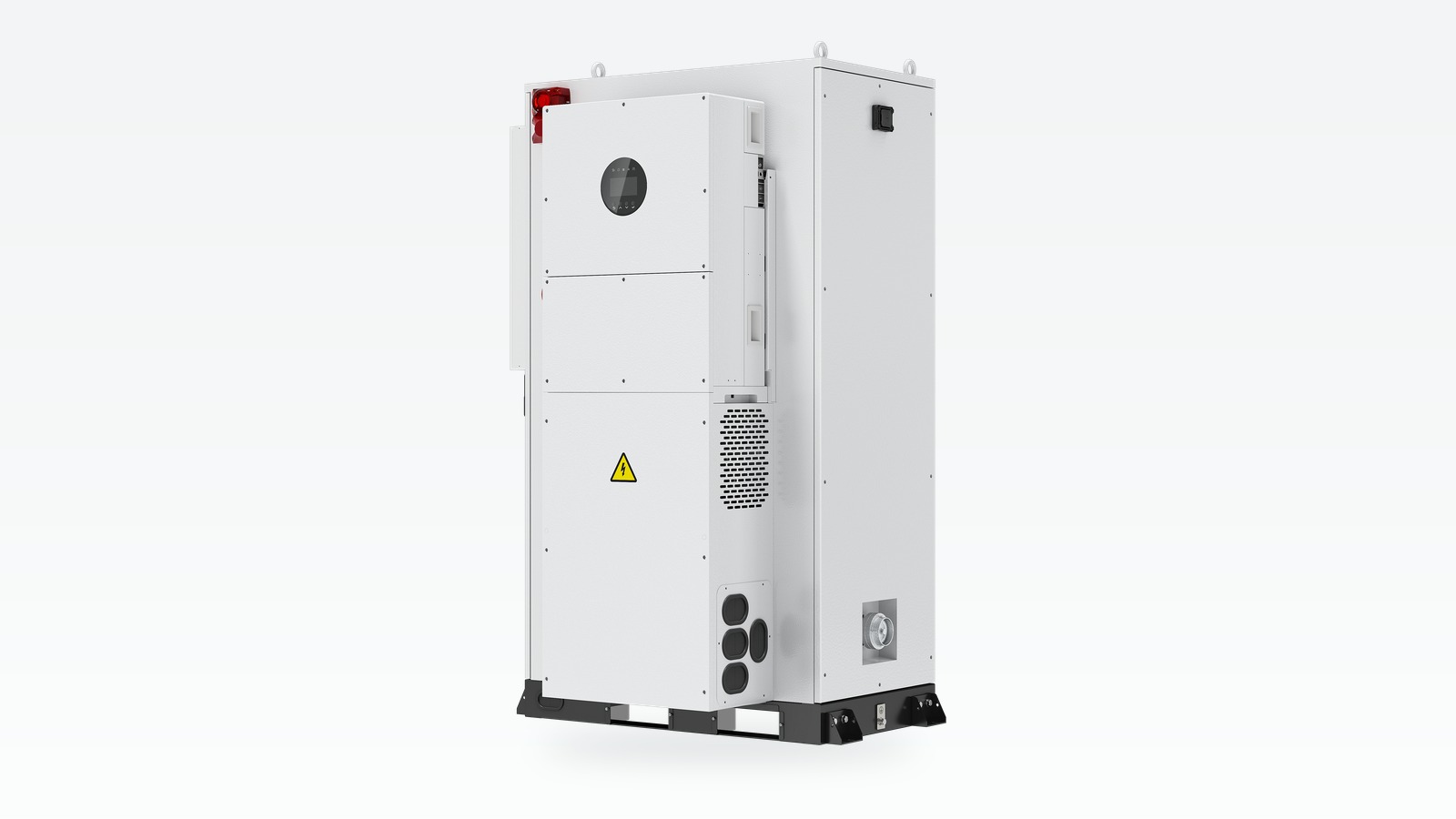
Most commercial battery projects are a battery cabinet, a separate inverter, a transfer switch and a generator controller, wired together on site by two or three suppliers. This cabinet does all four jobs in one factory-built enclosure, which is why the site work is hoisting and connection rather than system assembly.
What is the BES-H37.5X80? It is a 37.5 kW / 80 kWh outdoor hybrid energy storage cabinet. It combines a five-MPPT hybrid inverter, 80 kWh of LFP battery, a static transfer switch and a generator dry contact in one IP55 enclosure, with 72 kWh usable at 90% depth of discharge.
The Numbers, Without the Marketing Layer
These are the values from the datasheet and the technical agreement. Where the two documents disagreed during verification, the datasheet figure is the one printed here.
| Parameter | Value |
|---|---|
| Model | BES-H37.5X80 |
| AC power | 37.5 kW |
| Apparent power | 37.5 kVA |
| Battery energy | 80 kWh |
| Usable energy | 72 kWh |
| Rated output current | 57 A |
| Maximum output current | 57 A |
| PV input, max | 75 kWp |
| MPPT trackers | 5, two strings each |
| Max string current | 22.5 A per string (45 A per MPPT channel) |
| Dimensions | 1349 × 2100 × 990 mm |
| Weight | 1025 kg |
| Grid connection | 3L/N/PE 380/400/415 V 50/60 Hz |
| PV input, max | 1100 V |
| MPPT range | 150-1000 V |
| Battery cell | LFP 314 Ah |
| Battery configuration | 1P20S per pack, 6 packs in 120 kWh |
| Depth of discharge | 90% |
| Inverter efficiency | 98.4% max / 98.0% European |
| Round-trip efficiency | 88% |
| Protection | IP55 cabinet / IP66 inverter |
| Corrosion | C4 standard, C5 optional |
| Warranty | 5 years on pack, inverter and cooling; 2 years on fire suppression |
| Warranty start | 60 months from installation or 66 months from factory shipment, whichever comes first |
| Performance commitment | 6,500 cycles or 10 years to 70% SOH at 25 C, 0.5P, 90% DoD |
Certificates held: CB IEC 62619:2022, CB IEC 63056, CEI 0-21 (Italy). Compliance reports cover IEC 62477-1, the EN IEC 61000 series, IEC 61727 and 62116, EN 50549-1 and -10, IEC 62109, IEC 60730 and UN38.3. UL 9540 and NFPA 855 are not held.
What 72 kWh Usable Does for Your Building
Usable energy is the number that matters, not nameplate. At 90% depth of discharge the 80 kWh battery gives 72 kWh. At the cabinet's own 37.5 kW output that is about 1.9 hours of full-power discharge.
Most sites do not cycle that deep. A shallow daily cycle of 90 kWh, for example, keeps the battery inside its comfort zone and still moves a real share of the evening load. Depth of cycle, tariff windows and the size of the PV array decide the actual daily throughput.
Charging is the same channel in reverse. From empty the battery takes about two hours at the cabinet's rated charge power and about four hours when the site caps charging at half of that. The cap is a commissioning setting chosen to fit the incoming supply and the tariff windows, so a smaller supply means a longer charge, not a different cabinet.
- Peak shaving: the cabinet covers the top of the load curve for the 15-minute window your utility bills on.
- Solar self-consumption: surplus PV charges the battery first, then goes to the grid if export is allowed.
- Backup: essential loads move to the cabinet in under 10 ms, with 150% overload for 10 s to start motors.
What Is Actually in the Box
| Part | Detail |
|---|---|
| Inverter | Five-MPPT hybrid inverter, IP66, 98.4% peak efficiency |
| Battery | 314 Ah LFP cells, 1P20S per pack, 4 packs |
| BMS | Cell sampling, state of charge and health, balancing, protection |
| Transfer | Static transfer switch, internal, under 10 ms |
| Generator | Dry contact for start and stop, no external ATS |
| Safety | AFCI, aerosol suppression, smoke and temperature sensors, emergency stop |
| Cooling | Air cooling, aluminium-nitride heatsinks, no coolant loop |
Civil works and the cable from the cabinet to your switchgear are deliberately outside the cabinet scope. They depend on your building, not on the product, and pretending otherwise is how a cheap quote turns expensive.
Where This Rating Fits, and Where It Does Not
This cabinet suits sites with a peak near 40 kW and short backup windows, where a 72 kWh daily cycle is enough.
- It does not suit a site whose peak sits well above 37.5 kW for long periods, because the cabinet will clip the top of the curve instead of shaving it.
- It does not suit a site that needs more than about 1.9 hours at full power without adding battery cabinets on the DC side.
- It does not suit 208 or 220 V networks. The Latin American line is a separate product family at 30 and 35 kW.
How This Model Grows, Ships and Gets Documented
- Up to three additional battery cabinets on the DC side, to 480 kWh, with power unchanged.
- Up to ten units in parallel on the AC side, 600 kW and 4.8 MWh in total.
- Shipped at 30% state of charge or below, with UN38.3 test summaries for the cabinet and the pack.
- Eight units fit a 20-foot container; sixteen fit a 40-foot container.
- Documents are issued within 15 days of contract: nameplate drawing, manuals, certificate of conformity, test reports.
- Spare parts ship from four regional depots: EU, South Africa, Pakistan and Brazil.
Questions about this model
How long does it take to charge the battery?
About two hours from empty at rated charge power, and about four hours when charging is capped at half of that. The cap is set at commissioning to match the incoming supply and the tariff windows. Charging slows near full, so plan on a two-to-four-hour window rather than the arithmetic alone.
How long does the warranty run?
Five years on the battery pack, the inverter and the cooling unit, and two years on the fire suppression. The clock starts at installation, counted as 60 months from installation or 66 months from factory shipment, whichever comes first. An extension to ten years is available.
Can the cabinet work without a diesel generator?
Yes. The generator interface is a dry contact that starts and stops a generator when one is present. Without a generator the cabinet runs from PV and grid, and holds the essential loads in island mode.
What happens if the battery reaches its cycle limit?
The performance commitment is 6,500 cycles or ten years to 70% state of health at 25 °C, 0.5P and 90% depth of discharge. Cells are tested to 8,000 cycles; the contractual figure is the more conservative one.
Does it need a coolant change or a chiller?
No. Cooling is air across aluminium-nitride heatsinks with separate air paths for the power stage and the battery compartment. There is no coolant loop and no chiller to service.
Can I buy the battery cabinet without the inverter?
The LuminBlock H series is an all-in-one unit. If you only need DC battery cabinets, the BHF-X80D, X100D and X120D cabinets are the separate product line and are quoted as such.
Request a Quote
Seven fields, no attachments. We aim to reply within two working days of a complete enquiry, with the scope broken out and every assumption written down. If a cabinet does not make sense for your site, we say so.