Shift Change Is the Expensive Fifteen Minutes
Yes, where the load peaks in short bursts at shift change or at charger start. The cabinet covers the burst and refills between shifts. A site that runs at its ceiling for the whole shift needs more capacity rather than storage.
At 06:00 the conveyors start, the dock doors open, the chillers pull down and twenty forklifts go on charge. The quarter-hour average jumps, and the demand register keeps it for a month.
The same pattern repeats at every shift change. Three spikes a day set the bill for a site that is otherwise steady.
Forklift Chargers Are the Biggest Single Load
A bank of lead-acid or lithium chargers draws its full rating for the first hours of a charge and then tapers. Twenty chargers starting together is the largest step on most warehouse sites, larger than the conveyor drives.
The cabinet covers the start of the bank at 150% of its rating for 10 seconds. It then carries the charge taper while the site's other load runs. The chargers see full current and the meter sees a limit.
- Charger start is staged or absorbed, so the site import stays inside its rating.
- Conveyor and door drives on an outage board keep the sort running while the grid is down.
- Cold rooms attached to the warehouse go on the same essential board as the controls.
The Service Rating You Do Not Have to Buy
A service upgrade means a new transformer, new switchgear and a shutdown, and the utility's lead time is often the longest item in the project. A cabinet sits behind the existing meter and adds capacity without touching the connection.
The cabinet adds 60 kW per unit at up to 600 kW in parallel. A site that needs 200 kW of extra headroom uses four cabinets and keeps its switchgear, its connection agreement and its shutdown-free programme.
Storage is not a substitute for capacity over a full shift. If the site's average load already exceeds the service rating, the upgrade is the honest answer and we will say so.
From One Dock to a Distribution Centre
| Site | Cabinets | Covers |
|---|---|---|
| Single warehouse | 2 | Shift-change spike, charger bank |
| Distribution centre | 4 | Two docks, cold rooms, conveyors |
| Logistics park | 10 | 600 kW and 4.8 MWh on one controller |
The count follows the gap between the site's peak and its service rating, and the hours the site runs above that rating. A fifteen-minute spike needs power rather than energy, which is the cheaper half of the cabinet.
A site with cold rooms adds hours, because the stock has to be protected rather than the sort. That is when a second or third cabinet earns its place.
Where It Stands and Who Connects It
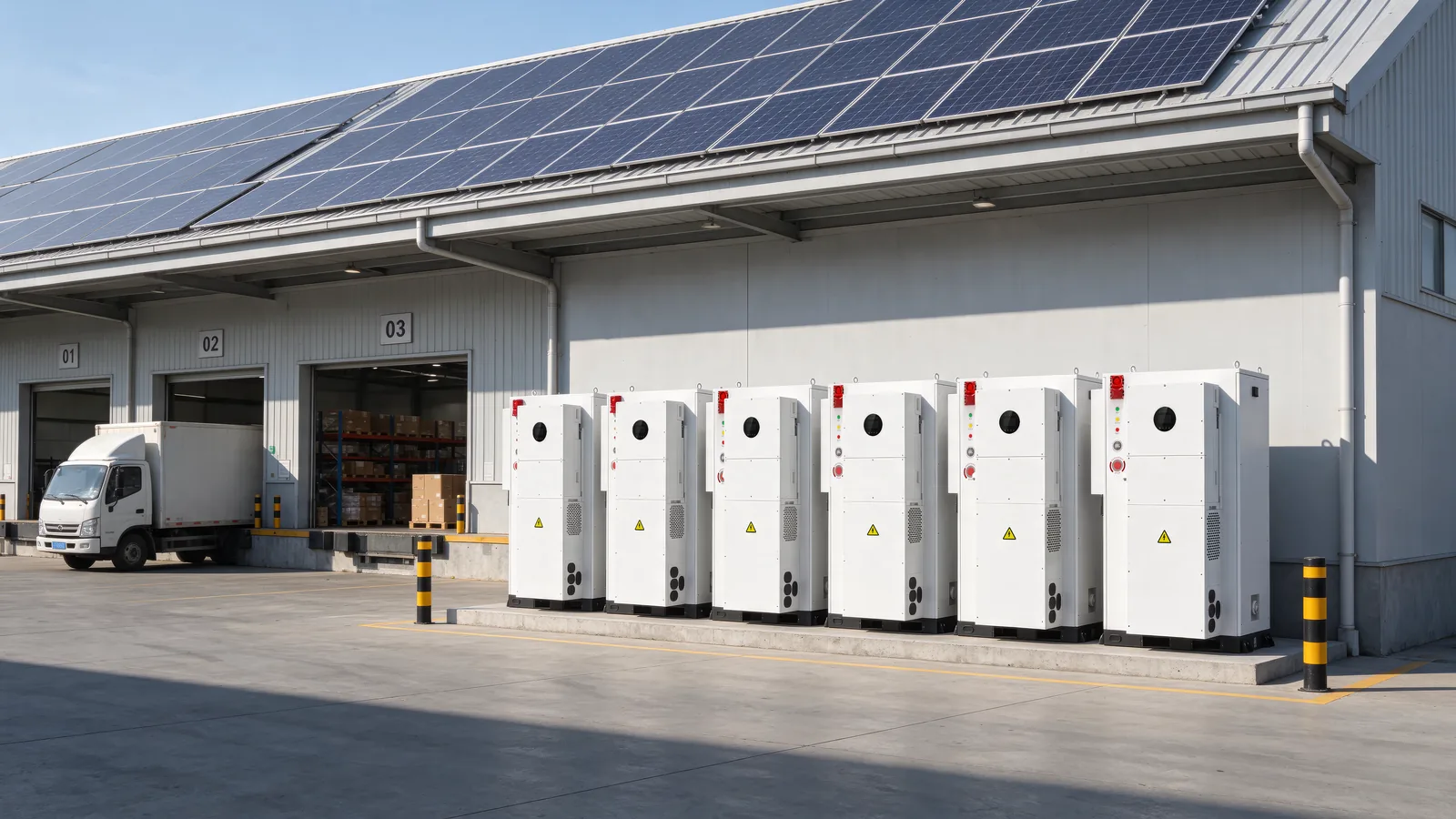
The cabinet stands outdoors at 1349 by 2100 mm on a 990 mm base, against a wall or beside the switchroom. It is IP55 with the inverter at IP66, and the C5 coating option covers coastal and washdown areas.
The cabinet includes the inverter, six packs, the BMS, aerosol fire suppression and cooling. The foundation, the cable route and the external cabling sit outside the supply scope, and the proposal lists who does each.
The Terms a Warehouse Buyer Should Compare
Certificates are CB IEC 62619, CB IEC 63056 and CEI 0-21. Warranty is 5 years on pack, inverter and cooling unit and 2 years on fire suppression. Cover starts 60 months after installation or 66 after shipment, extendable to 10.
Compare the cycle life as well as the warranty. 6,500 cycles at 90% depth of discharge is the published figure. A site that cycles twice a day reaches it before the calendar limit does.
Questions about warehouse battery storage
Can I avoid a service upgrade?
Where the peak is short and repeats, yes. Two cabinets add 120 kW of discharge for the shift-change window and recharge between shifts. A site whose average load exceeds its rating needs the upgrade, and storage will not hide that.
Will it cover the forklift chargers?
It covers the start of the bank and the taper while the rest of the site runs. Twenty chargers starting together is the largest step on most sites, and the survey measures it rather than assuming a nameplate figure. The charger bank is measured in the site survey rather than assumed from nameplates.
What happens during an outage?
The circuits on the essential board keep running: controls, conveyors, cold rooms and security. The transfer takes under 10 ms. Which circuits make the board is agreed at commissioning, and the runtime follows that list. A site that adds cold rooms later adds cabinets for the hours.
How many cabinets for a distribution centre?
Four covers most two-dock sites with cold rooms and a charger bank. Up to ten run in parallel on one controller for 600 kW and 4.8 MWh. The count follows the gap to the service rating and the hours above it.
The Service Rating and the Charger List
Tell us the connection size, the charger bank and the shift pattern. You get the cabinet count, the peak the site will hold and the outage cover, in writing.