The Array and the Load Rarely Peak Together
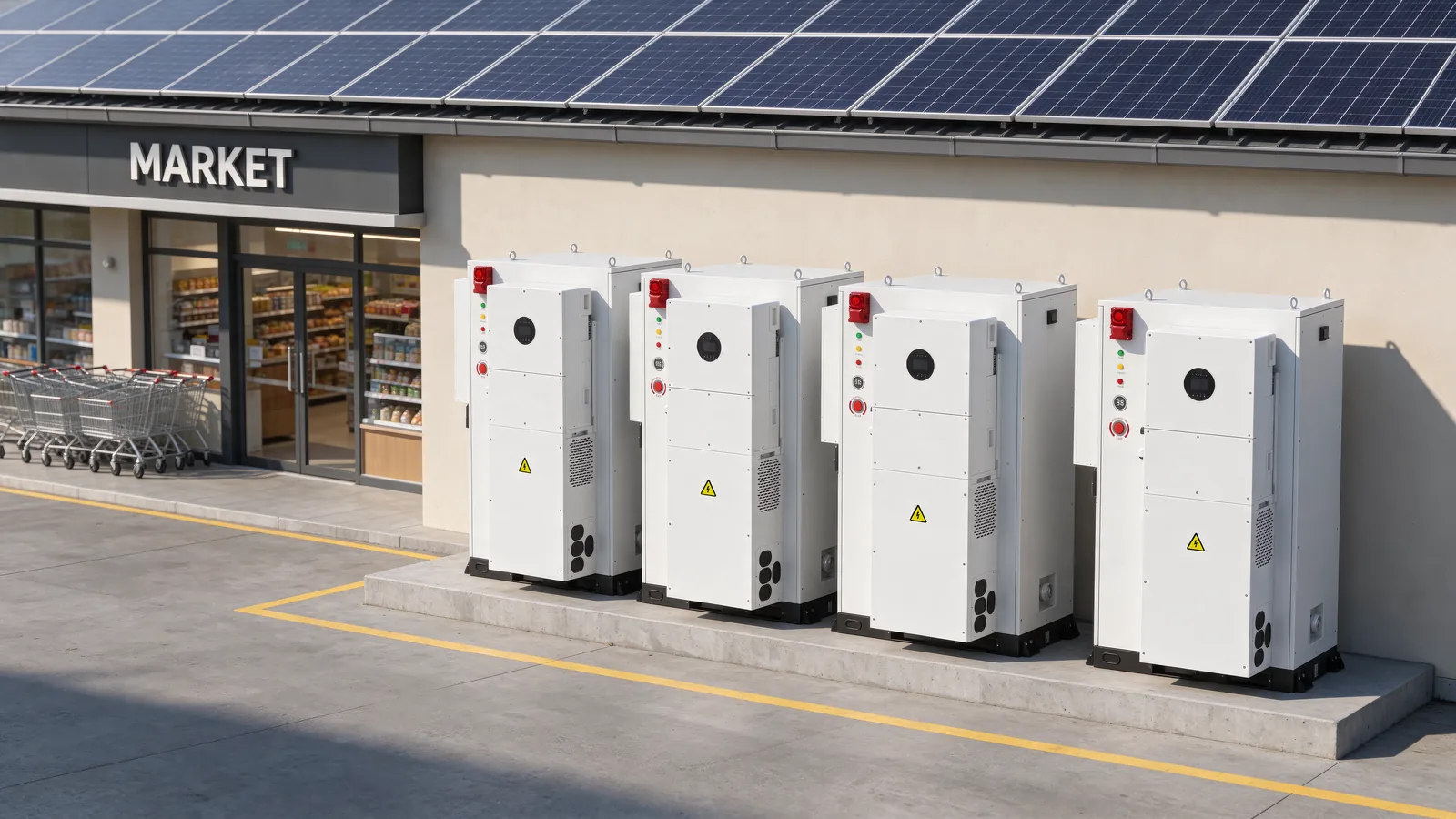
Yes, if the site exports surplus at midday and buys power back in the evening. The cabinet stores the surplus and discharges when the site's draw exceeds what the array makes. Oversizing to 200% of rated power lets a 60 kW cabinet take 120 kWp of modules.
A 100 kWp array on a site that draws 40 kW at noon sends 60 kW toward the meter. Where export is metered and paid at a lower rate, that 60 kW earns less than the same energy would save in the evening.
The tariff decides how much this matters. A site paid the same for export as it pays for import has little to gain. A site paid a third of the import price has a clear gap to close.
Two Hundred Percent DC Input on One Cabinet
Each cabinet accepts PV up to twice its rated power. The array can be built for the roof's own yield instead of being clamped to the inverter. The extra generation clips at midday rather than damaging the unit.
| Cabinet | Rated power | Max PV input | MPPTs |
|---|---|---|---|
| BES-H37.5X80 | 37.5 kW | 75 kWp | 5 |
| BES-H40X80 | 40 kW | 80 kWp | 5 |
| BES-H49.9X100 | 49.9 kW | 99.8 kWp | 5 |
| BES-H50X100 | 50 kW | 100 kWp | 5 |
| BES-H60X120 | 60 kW | 120 kWp | 5 |
Input runs to 1,100 V with the MPPT window from 150 to 1,000 V. Full power tracks from 225 V on the 37.5 and 40 kW units. On the 49.9 and 50 it tracks from 270 V, and on the 60 from 320 V.
Surplus Fills the Pack Before It Reaches the Meter
When generation exceeds site load, the controller diverts the difference into the battery. The 120 kWh cabinet holds 108 kWh usable, and a 60 kW surplus fills it in under two hours of good sun.
The same energy comes back in the evening. A site that shifts 108 kWh from midday to the evening avoids buying it at the evening rate. Round-trip efficiency of 88% means about 95 kWh reaches the load.
Zero-export mode holds the site at the meter when the network operator caps what can be sent back. Surplus goes to the battery first, and the array curtails when the pack is full.
Cloudy Weeks and Export Caps
A three-day overcast stretch does not fill the pack, and the site falls back to the grid. Storage shifts energy across a day or two; it does not create a week of it.
Where the network operator limits export to a fixed kVA, the cap applies to the whole site connection. The cabinet can absorb the surplus instead of curtailing it, which is often the reason the array can be built at full size.
A site with no PV can still use the cabinet for peak shaving. The PV input is a connection point, not a requirement.
What the Site Needs Before the Array Goes Up
- Roof or ground space with a yield figure from a shading study rather than a guess.
- A switchboard position for the AC connection and a cable route to the cabinet.
- A tariff with a gap between import and export price, or an export limit that curtails.
- A network operator application for the connection, which the installer usually files.
The cabinet stands outdoors, so the array and the battery do not compete for the same roof. That matters on a site where the roof is the only space available.
Documents, Terms and What Ships
The cabinet holds CB IEC 62619, CB IEC 63056 and CEI 0-21. Fire suppression, AFCI and string-level shutdown are inside the enclosure, and the DC isolators sit at the cabinet.
Warranty is 5 years on pack, inverter and cooling unit plus 2 years on fire suppression. It counts from 60 months after installation or 66 after shipment, extendable to 10 years.
Solar Battery Meaning, Size and Space
Solar battery meaning in a commercial context: the battery stores surplus PV instead of exporting it, then releases it after sunset or when the site peak arrives. What is a solar battery and how does it work? It is the same LFP cabinet described on this site, charged by the array through its PV inputs.
How big is a solar battery, and what are its dimensions? This range runs 80, 100 and 120 kWh, all in one enclosure of 1349 × 2100 × 990 mm. Solar battery dimensions do not change with capacity because the extra energy comes from more packs inside the same cabinet, so how much space does a solar battery take up is answered once: a footprint under one square metre plus the clearance the installation guide requires.
What is a solar battery storage system made of? Cells, a battery management system, a hybrid inverter, a static transfer switch, fire suppression and cooling. What is a solar battery storage system compared with a plain battery: the plain battery has no inverter and no transfer switch, so it cannot run the site on its own.
How Solar Batteries Work with Panels, Day and Night
How do solar batteries work with solar panels? The array feeds the cabinet's PV inputs first; surplus charges the battery; only what is left is exported. How do solar batteries store energy? As direct current in LFP cells, converted to AC on the way out.
How do solar batteries work at night? They discharge into the site board from the stored energy; there is no PV input after dark, so the night is exactly what the battery was charged for. How to store solar energy for later use is therefore a sizing question, not an equipment question: the kWh you carry into the evening is the kWh you can use.
This is also why the daytime strategy matters: charging from surplus avoids export at a low price, and discharging into the peak avoids import at a high one. The control mode decides which of those two the cabinet favours.
Are Solar Batteries Worth It 2026? A Decision Framework
Are solar batteries worth it in 2026? The question is the same every year: does the site have a spread to move, or a peak to cut? Are solar batteries worth it without solar panels? They can be, if the tariff spread is wide enough, because the cabinet can charge from cheap grid power and discharge at peak.
Do solar batteries save money? They save where self-consumption replaces import at a higher price, and where the discharge cuts a demand charge. The saving comes from the tariff, not from the battery on its own, which is why we ask for a bill first.
A solar and battery bundle is usually quoted as one package; ask for the solar panel and battery package cost to be split into array, battery and site works, or the comparison against a battery-only quote will not be like for like.
Solar PV and Battery Storage Systems for Commercial Buildings
A solar pv battery storage system on a commercial building is sized from two numbers: the kWp the roof can take and the kWh the evening needs. Solar PV and battery storage cost follows the second number more than the first, because the battery is the expensive part per kWh.
Solar PV and battery storage solutions for commercial buildings usually start with the essential board, not the roof: what has to stay on, for how long, and what the transformer can already carry. The 60kW 120kWh all-in-one energy storage system is the largest single cabinet here; larger sites parallel up to ten.
The Names Buyers Use for Solar Battery Storage
Solar battery storage, solar panel battery storage and storage battery solar all describe the same thing on a commercial site: a battery that stores the array's output instead of exporting it. The cabinet adds two things the array cannot do alone. It shifts the midday surplus to the evening peak, and it keeps the essential board on during an outage.
The vocabulary changes by market and by trade. A buyer searching solar panel battery storage usually means a packaged PV and battery system; a specifier writing storage battery solar may mean the DC-coupled battery block. On this site both route to the same cabinet, because the difference sits in the array design, not in the battery.
| Phrase | What it usually means |
|---|---|
| solar panel battery storage | A PV array with a battery, usually sold as one package |
| storage battery solar | The same idea written from the battery side; often DC-coupled |
| batteries for solar power storage | The battery block itself, sized in kWh |
| solar array battery storage | The array and the storage sharing one site connection |
| solar panels and battery storage | A combined quotation covering both parts |
| pv panel battery storage | Older wording for the same pair |
| solar battery storage uk | The same system specified for a 380–415 V, 50 Hz site |
| solar panels with battery storage | On a C&I site: the array and the cabinet sharing the board |
| solar power and battery storage | The same pair, written as a supply term |
| solar storage battery | The battery block, in trade shorthand |
| solar energy battery storage | The storage part of a PV system |
| solar power battery storage | The same, in search phrasing |
| solar storage batteries | Plural trade wording for the battery block |
| storage battery for solar panels | What the battery is for, written from the array side |
If a supplier uses one of these phrases, ask what the quote includes at the battery end: the cabinet, the meter and CTs, the cable to the switchgear, and the grid application.
Questions about commercial solar battery storage
Can I oversize the array to 200%?
Yes. Each cabinet takes PV up to twice its rated power: 75 kWp on the 37.5 kW model and 120 kWp on the 60 kW model. The limit is the DC input rather than the roof, so a larger array clips at midday and the unit stays inside its rating.
What happens when export is limited?
Zero-export mode holds the site's export at the meter. Surplus goes to the battery, and the array curtails when the pack is full. That keeps the site inside the operator's limit without switching the array off. The controller reads the meter and the pack, and the export limit is set at commissioning.
Is it worth it without an export tariff?
It depends on the gap between what you pay for power and what you are paid for export. With no gap, the case rests on an export limit or on peak shaving, and a smaller array may suit the site better.
What does a cloudy week do?
The array makes less, the pack fills less, and the site buys more from the grid. Storage moves energy across a day or two and does not replace a week of missing generation. Sizing uses the site's own yield data.
How does commercial solar battery storage work?
The array charges the battery first and the site second. Surplus that would leave at the export price charges the pack instead, and the cabinet discharges it in the evening or under a demand peak. The PV input takes up to 200% of the inverter rating.
Can you supply the solar PV and battery storage as one package?
We supply the battery cabinet and the interface to the array. The PV array itself is usually quoted by an EPC or installer; if you want one package, we work with them on the same scope so the documents line up.
What is a solar battery and how do solar batteries work?
A solar battery is the storage half of a PV system: it takes the array's surplus and delivers it back when the site needs it. The cabinet charges first from PV, then from the grid if a window is set, and discharges into the site's board.
How big are solar panel batteries for a commercial site?
Commercial cabinets in this range hold 80, 100 or 120 kWh, of which 72, 90 or 108 kWh is usable at 90% depth of discharge. A site using 800 to 1,500 kWh a day usually lands on the 100 kWh model.
Can the array and the battery be bought as a solar and battery package?
We quote the cabinet, the metering and the interface to the array as one scope. The PV array is usually quoted by an EPC or installer, and we can price a solar and battery package together with them so the documents line up.
Are solar batteries worth it for a business?
That depends on the gap between your import price and your export price, and on whether the site already has a demand charge worth cutting. We run the arithmetic on your own figures before anyone sends a proposal.
How is solar energy stored on a commercial site?
The array's DC output charges the battery through the cabinet's MPPTs, and the energy stays in LFP cells until the site draws it back. Storing solar energy this way keeps the surplus behind the meter instead of exporting it at the export price.
What is commercial solar storage?
Commercial solar storage is the battery half of a PV install: it takes the output the site cannot use at that moment and gives it back in the evening or during a peak. Sized with the array, it decides how much of the solar is self-consumed rather than exported.
Can solar and battery storage be sized as one system?
Yes, and they should be. Solar and battery storage sized together use the array's real output profile and the site's real load profile. Sized separately, the battery ends up too small for the evening peak or too large for the array.
Do you supply solar battery storage for business sites only?
Solar battery storage for business is what this page is sized for: three-phase sites behind a 100–400 kVA transformer. A house or a villa is below the scale of this cabinet; the manufacturer makes residential systems and we will point you at them.
What is solar panel battery storage on a commercial site?
It is a PV array with a battery cabinet on the same site connection. The array charges the battery when generation exceeds the building load; the battery discharges into the evening peak or holds the essential board during an outage. The quote should say whether both parts are inside it.
Is solar battery storage in the UK specified differently?
The electrical rules are the same as the rest of this range: 380–415 V, 50 Hz, three-phase. What changes is the connection process. The DNO has to accept the array and the battery on the site's existing supply, and that application usually takes longer than the physical installation.
What is the best solar battery storage for a UK site?
Best depends on the bill, not on the box. Three checks narrow it: whether the array's DC design fits the cabinet's MPPT window, whether the site may export or must limit export, and how much of the evening load the battery has to carry. A cabinet that wins on those three is better than one that wins on a spec sheet.
The Array Size and the Tariff
Tell us the array in kWp, the export arrangement and a recent bill. You get the cabinet count, the storage it adds and the clip you should expect, in writing.