One Quarter Hour Sets the Whole Month
Yes, if your tariff carries a demand charge and the peak is short. A cabinet rated 60 kW holds 60 kW off the site's draw while the battery has energy. That lowers the average the meter records in each 15-minute interval. The method fails when the peak lasts longer than the energy allows.
Most commercial demand charges work from a 15-minute average. The meter records the average kW in each interval, and the highest interval in the billing month sets the charge. Some tariffs also ratchet, so the highest peak of the last 11 or 12 months sets a floor you cannot fall below.
That structure rewards one thing: removing the top few kW from the worst quarter hour. It does not reward using less energy overall. A site that shaves 60 kW from its monthly peak changes one line on the bill. A site that runs 60 kW lower all month changes several.
Sixty Kilowatts Off the Peak, Held Through the Window
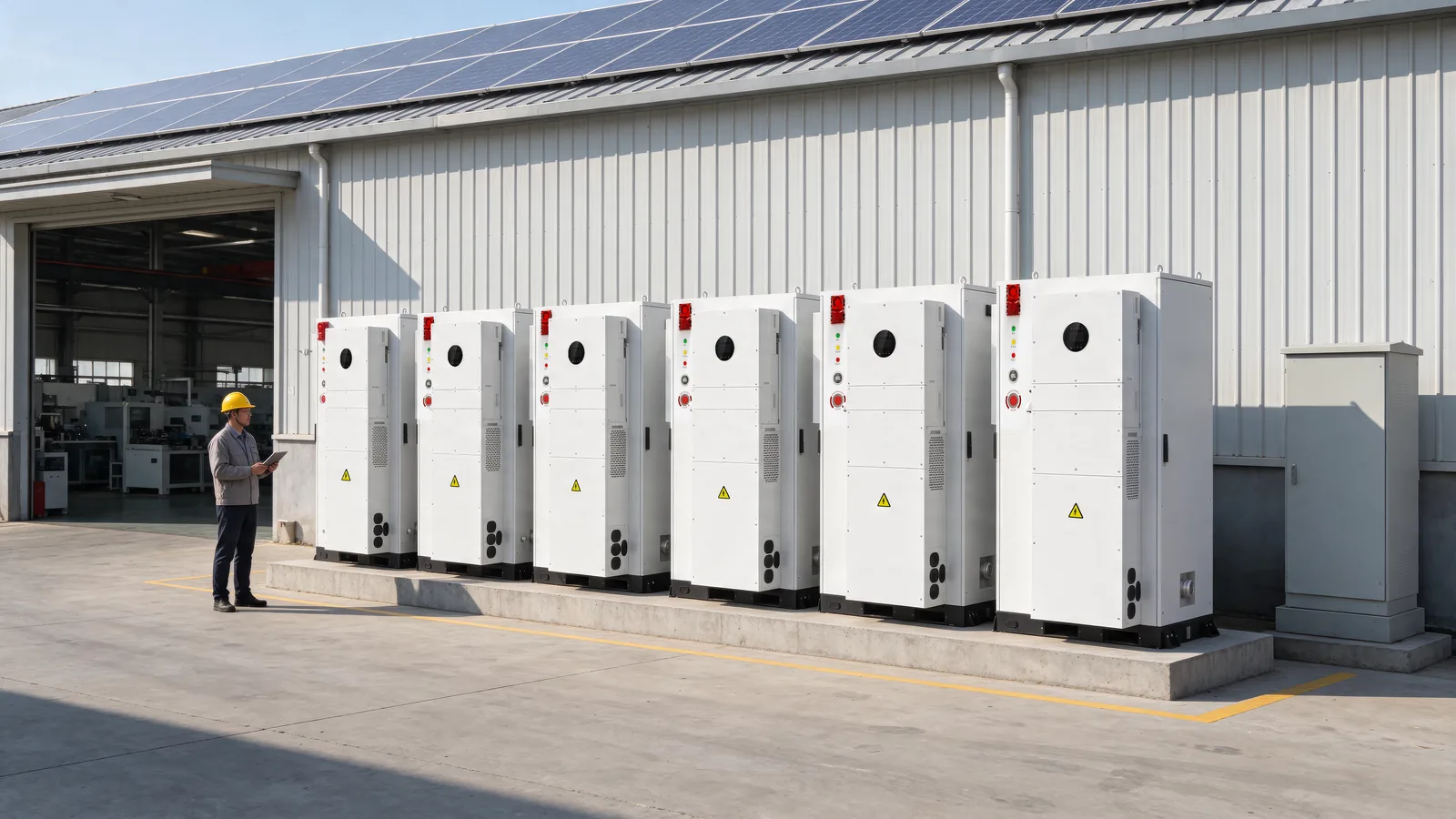
The cabinet discharges when the controller sees the site's draw approach the cap you set. A 60 kW unit covers a 60 kW peak for 1.8 hours on 108 kWh of usable energy. Shorter peaks are the normal case: a 60 kW cut for one 15-minute interval uses 15 kWh, about 14% of the pack.
Two cabinets double the cut to 120 kW and the energy to 216 kWh. The enclosure does not change: same footprint, same terminals, same commissioning routine. Up to ten units work as one plant at 600 kW and 4.8 MWh.
Match the Cabinet Count to the Peak You Want Gone
Start with the kW you want off the peak, then check the energy. A cut that needs more kWh than the site can store becomes a shorter cut or a bigger system.
| Peak to remove | Cabinets | Power | Usable energy |
|---|---|---|---|
| Up to 50 kW | 1 x BES-H50X100 | 50 kW | 90 kWh |
| Up to 60 kW | 1 x BES-H60X120 | 60 kW | 108 kWh |
| Up to 120 kW | 2 x BES-H60X120 | 120 kW | 216 kWh |
| Up to 180 kW | 3 x BES-H60X120 | 180 kW | 324 kWh |
| Up to 600 kW | 10 units in parallel | 600 kW | 4.8 MWh |
The 37.5 and 40 kW cabinets suit smaller peaks: 72 kWh usable and 75 to 80 kWp of PV input on the same enclosure.
Request a quote, or twelve months of interval data if you have it, and the sizing comes back as a kW figure and a kWh figure. The peak window it was built on is written down beside it.
When the Peak Outlasts the Battery
A site that holds its peak for four hours needs 240 kWh at 60 kW. One cabinet carries 108 kWh, so the cut either shortens or the site adds cabinets. The arithmetic is worth doing before the order.
A ratchet set by a peak from last summer cannot be shaved retrospectively. The cabinet lowers the peak from the month it is commissioned. The floor from past months stays until it ages out of the tariff window.
If your bill carries no demand charge, a cabinet sized for peak shaving is the wrong purchase. Time-of-use arbitrage or backup may still justify one, and the peak argument does not apply.
The Cabinet Watches the Window While the Line Runs
The controller tracks site load at the meter, compares it with the cap, and discharges on the difference. Response is automatic, and nobody watches a screen at 14:00.
- Peak shaving runs alongside time-of-use arbitrage and demand-side response in one controller.
- Transfer to backup takes under 10 ms if the grid fails during a shave.
- Every event is logged, so the monthly report shows the kW removed and the interval it came from.
A site with no network link keeps shaving. Only the remote reporting pauses, and it catches up when the link returns.
Documents and Terms You Can Read First
Ask for the CB IEC 62619 and CB IEC 63056 certificates, the CEI 0-21 certificate for Italy, and the warranty terms before signing anything.
- 5 years on pack, inverter and cooling unit, with 2 years on fire suppression.
- Cover runs 60 months from installation or 66 months from factory shipment, whichever comes first.
- Extension to 10 years is written into the contract rather than promised on a call.
The cabinet is IP55 with C4 corrosion protection as standard and C5 as an option, so a coastal site can be specified without a shelter.
Questions about peak shaving battery storage
How much of my peak can one cabinet remove?
One cabinet removes up to its rated power: 37.5 to 60 kW depending on the model. The 60 kW unit holds that cut for 1.8 hours on 108 kWh usable. Longer peaks need more cabinets, and the energy check comes before the power check.
Will peak shaving affect production?
No. The cabinet adds power behind the meter and takes none away. The line sees the same supply plus the battery, and transfer to backup takes under 10 ms if the grid fails during a shave. Nothing on the plant floor changes.
What price spread makes it worthwhile?
The spread on your own tariff decides it. We do not quote a percentage before seeing the bill, because the demand rate, the peak window and the ratchet length all move the number. Request a quote and the arithmetic comes back open.
How many cycles does it run a day?
One cycle a day is the normal pattern for peak shaving, with the pack charged before the peak window and discharged through it. A site with a wide tariff spread can run two, at the cost of more cycles against the 6,500-cycle warranty basis.
How is battery wear accounted for?
The warranty covers 6,500 cycles or 10 years to 70% state of health at 25 C, 0.5P and 90% depth of discharge, and the cells are tested to 8,000 cycles. A daily shave cycle stays inside that basis, and the report tracks the cycles used.
What is peak shaving in energy storage?
Peak shaving is discharging a battery during the site's highest-power hours so the import from the grid stays below a chosen ceiling. It lowers the demand charge and can avoid a transformer upgrade. The battery does not reduce total consumption; it moves it to cheaper hours.
The Peak Is the Number That Matters
One recent bill with the kW line visible, plus interval data if you have it. You get a cabinet count, the kW it removes and the intervals it covers, with every assumption written down.